August 2009
Woody Guthrie: A Songwriter for All
Seasons
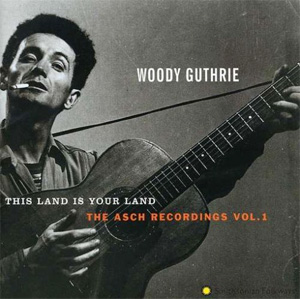 As hard times
sweep across the American landscape, and throughout the human world, more broadly and
deeply than at any time since the Great Depression, some people have been dusting off John
Steinbeck’s The Grapes of Wrath -- the classic novel about the travails of the
Joad family, all but one member of which abandon their Oklahoma dustbowl home, bound for
the purported Eden of California’s "fruit bowl." It’s also a good time
to dust off our recordings of Woodrow Wilson "Woody" Guthrie, a long list of
which are currently available, as well as the covers of his songs by Pete Seeger, Joan
Baez, Bruce Springsteen, and countless other excellent but less-well-known artists,
including Guthrie’s friend Ramblin’ Jack Elliott -- of whom Guthrie once said,
"He sounds more like me than I do." As hard times
sweep across the American landscape, and throughout the human world, more broadly and
deeply than at any time since the Great Depression, some people have been dusting off John
Steinbeck’s The Grapes of Wrath -- the classic novel about the travails of the
Joad family, all but one member of which abandon their Oklahoma dustbowl home, bound for
the purported Eden of California’s "fruit bowl." It’s also a good time
to dust off our recordings of Woodrow Wilson "Woody" Guthrie, a long list of
which are currently available, as well as the covers of his songs by Pete Seeger, Joan
Baez, Bruce Springsteen, and countless other excellent but less-well-known artists,
including Guthrie’s friend Ramblin’ Jack Elliott -- of whom Guthrie once said,
"He sounds more like me than I do."
The familiar refrain of Woody Guthrie’s most famous
song, "This Land Is Your Land," is usually also sung as the opening verse:
This land is your land, this land is my land
From California to the New York Island
From the redwood forest to the Gulf Stream waters
This land was made for you and me.
Folk musicians and sing-along fanciers know the first three
verses, each ending with the refrain’s last line:
As I was walking that ribbon of highway
I saw above me that endless skyway
I saw below me that golden valley
This land was made for you and me.
I’ve roamed and rambled and I followed my footsteps
To the sparkling sands of her diamond deserts
And all around me, a voice was sounding:
This land was made for you and me.
When the sun came shining and I was strolling
And the wheat fields waving and the dust clouds rolling
As the fog was lifting, a voice was chanting
This land was made for you and me.
Of those three verses celebrating "our"
land’s richness and beauty, the second and third invoke a voice -- ostensibly an
inner one stirred by the singer’s experience of the land -- insisting that such
abundance and beauty must exist for all: By virtue of one’s humanity, one lives on it
and is humbled by it.
Hardly known, but published in the popular 1200-song Rise
Up Singing: The Group Singing Songbook (edited by Peter Blood and Annie Patterson),
and in Woody Guthrie Songs (edited by Judy Bell and Nora Guthrie, with an excellent
discography; TRO Songways Service), are the three verses that follow:
As I went walking, I saw a sign there
On the sign it said "No Trespassing"
But on the other side it didn’t say nothing
That side was made for you and me.
In the squares of the city, in the shadow of a steeple
By the relief office, I seen my people
As they stood there hungry I stood there asking
Is this land made for you and me?
Nobody living can ever stop me
As I go walking that freedom highway
Nobody living can make me turn back
This land was made for you and me.
Today, those three more-obscure verses are particularly
resonant. As I write, Bernie Madoff, 71, perpetrator of one of the biggest individual
pulled financial hoaxes to date, which wiped out thousands of people’s life savings
with impacts too far-reaching to be fully known as yet, has just received a prison
sentence of 150 years. His crimes might still be undiscovered had the financial markets
not crashed, beginning with the mortgage industry, which bases its earnings on the
land’s not belonging to you and me. However, tracts are always obtainable by
those who have plenty of what Guthrie calls the "do-re-mi" in the song of that
title (and innovatively covered by Ani DiFranco).
After Madoff’s sentence was handed down, one of his
victims said that what matters is not his punishment but what the government will do to
restore the victims’ money. Another said that since the exposure of Madoff’s
fraud, her life had been a living hell resembling a nightmare from which she can’t
wake. Others have been working multiple jobs, and some are living on food stamps.
Similar lives are now being lived by so many people
affected by the severe economic recession or depression we are currently enduring, and the
impacts on people in "developing" countries are so egregious that the news
industry’s focus on the Madoff case, and its treating of everything else as vague
statistics, downplays the situation’s enormity. These days, people at the
"relief office" may not be hungry; more likely they’re nurturing heart
disease, type 2 diabetes, or cancer from "supersize" portions of an
industry-serving American diet too rich in meat, dairy, eggs, fish, and sugar. But someone
has proven able "to turn them back on the freedom highway." And mortgage
foreclosures, whose primary cause before the crash was bankruptcy due to soaring medical
costs, have revived Guthrie’s question: "Is this land made for you and
me?"
By the time Woody Guthrie died, in 1967, having written
more than 1000 songs, the post-World War II G.I. Bill and the government "safety
nets," the latter part of the New Deal’s response to the Great Depression,
generated and maintained the largest middle class in our species’ existence. For the
vast majority, prosperity was taken for granted; even the comparatively poor and
disenfranchised were fed and sheltered.
It wasn’t that way when Guthrie’s father’s
real-estate business, begun in the first Oklahoma oil boom, went bust. Guthrie’s
sister was killed when a coal-oil stove exploded. His mother was put in an asylum, and was
later determined to have had Huntington’s disease, which eventually killed Woody
himself at age 55. When Guthrie’s father moved back to Texas, Guthrie "hit the
road . . . doing all kinds of odd jobs, hoeing fig orchards, picking grapes, hauling wood,
helping carpenters and cement men, working with water well drillers . . . I carried my
harmonica and played in barber shops, at shine stands" (American Folksong / Woody
Guthrie, Oak Publications, New York, 1961; cited in Irwin Stambler and Lyndon
Stambler, Folk & Blues: The Encyclopedia, St. Martins, New York, 2001).
Guthrie’s vagabond existence was like that of The
Grapes of Wrath’s Tom Joad, whom Guthrie portrays in a 17-verse tour de force,
with Joad’s name as the title, written "the night that I saw the moving picture The
Grapes of Wrath" (Woody Guthrie Songs). Unlike Guthrie, Joad flees the
hardships of Oklahoma with his family (though Joad later parts from them to escape the
law). The second verse of Guthrie’s masterpiece "Pastures of Plenty" gives
a concise lyrical picture of living the hard life without a safety net:
I worked in your orchards of peaches and prunes,
Slept on the ground in the light of your moon,
On the edge of your city you’ve seen us and then,
We come with the dust and we go with the wind.
Nor would Guthrie have joined in persecuting the
"illegal aliens" of our time, many of whom are among the estimated minimum
50,000 slaves in the U.S. today. Though not in the bonds of chattel slavery, outlawed now
for nearly a century-and-a-half, these workers are still dominated, abused, threatened
with death if they try to escape. They labor for almost nothing, as occurred for many
years after Emancipation because laws were not passed that would enforce the 13th
Amendment to the Constitution. As Guthrie’s much-covered "Deportee" puts
it,
The crops are all in and the peaches are rott’ning.
The oranges piled in their creosote dumps.
You’re flying ’em back to the Mexican border,
To pay all their money to wade back again.
Refrain:
Goodbye to my Juan, goodbye, Rosalita,
Adios mis amigos, Jesus y Maria;
You won’t have your names when you ride the big airplane
All they will call you will be deportees.
Some of us are illegal, and some are not wanted,
Our work contract’s out and we have to move on;
Six hundred miles to that Mexican border,
They chase us like outlaws, like rustlers, like thieves.
Note how Guthrie distances himself from the land’s
owners by addressing them with the second-person "you" and identifies with the
immigrants by calling them "my" Juan, et al. and adopting phrases of
their language. In "1913 Massacre," about a "murderous joke" by
"copper boss thugs and scabs" that killed 73 children of copper miners in
Calumet, Michigan, when labor had no legal protection and there was no recourse against
injustice and abuse by company owners, Guthrie starts by inviting the listener into the
scene, where "the miners are having their big Christmas ball . . . / Take a trip with
me in Nineteen-thirteen. / . . . I’ll take you to a place called Italian Hall. . .
."
I’ll take you in a door and up a high stairs,
Singing and dancing is heard everywheres.
I’ll let you shake hands with the people you see
And watch the kids dance ’round the big Christmas tree.
Guthrie understood how experiencing people as human beings
elicits empathy, and how people who make profit their top priority suppress empathy and
thus make it easy to cause others to suffer. The thugs in the song, hired by the bosses --
today we call them "corporate thugs" --
. . . stuck their heads in the door;
One of them yelled and he screamed, "There’s a fire."
A lady she hollered, "There’s no such a thing;
Keep on with your party, there’s no such a thing."
But the damage is done. "The gun thugs, they laughed
at their murderous joke, / And the children were smothered on the stairs by the
door." Now, a piano that we’ve heard a little girl play as partiers quieted to
hear her
. . . played a slow funeral tune,
And the town was lit up by a cold Christmas moon.
The parents, they cried and the miners, they moaned,
"See what your greed for money has done?"
Nor was Guthrie’s empathy limited to human beings --
witness the lullaby "Lay Down, Little Doggies" (doggies being old-time
cowboy slang for cattle):
Lay down, little dogies, lay down
We both gotta sleep on the cold, cold ground.
The wind’s blowin’ colder and the sun is goin’ down,
So lay down, little dogies, lay down. . . .
Here now we come to the end of our trail
Your hair, hide, and carcass to a stockyard I’ll sell.
I’ll see you in a tin can when you get shipped around
So lay yourselves down, little dogies, lay down.
Throughout, singer and cattle share their struggles and
experiences. "We blistered in the sun and we froze in the snow." Guthrie plainly
sympathizes with the animals, not with the "packinghouse town" they’re
headed for, or the stockyard where he’ll sell them.
Some comparisons between today and the Great Depression of
the 1930s are overblown. While today’s much-larger human population means that more
will suffer from any widespread catastrophe, as of June 2009 unemployment had reached to
only slightly below 10%; in the 1930s, it is estimated to have reached 25%. And back then,
little or no government safety net existed -- today’s programs were responses to the
suffering of those times. But the dynamics remain the same, and Guthrie beautifully
deciphers the human and moral components. He does not, as far as I know, distinguish
between actual persons, whom the Constitution and Bill of Rights exclusively aimed to
protect, and fictitious "persons" such as corporations, incapable of empathy or
any other experience, yet setting standards, creating incentives, and, since 1886, granted
the rights of actual persons through extra-Constitutional maneuverings (see in particular
Thom Hartmann’s Unequal Protection: The Rise of Corporate Dominance and the Theft
of Human Rights; Rodale Press, Emmaus, Pa., 2002). Hence his many references to bosses
and greed, but not to forces set in motion by humans but not themselves human.
Those old enough to have clear memories of the Great
Depression are now at least 75, and more likely 80 or older. In recent decades some of
them warned, as did some younger observers, about the dangers of financial deregulation,
to no avail. No matter who comes with the dust and goes with the wind, the line from
Guthrie’s classic ballad "Pretty Boy Floyd" -- "Some rob you with a
six gun and some with a fountain pen" -- is still true. Corporations now put pens --
and computers -- into hands trained not in factories, mines, and orchards, but in business
schools, and for the express purpose of putting the bottom line above any human or public
interest. One can easily imagine Guthrie asking What does anyone need an M.B.A. for --
aren’t they greedy enough without one? And perhaps deciding it stands for Money
Before All.
The word rob conjures images of weapons more than of
pen and paper, and this famous line also hints at the disproportionate attention paid to
violent crime over white-collar crime. The news industry’s having become part of the
entertainment industry -- "If it bleeds, it leads" -- leaves us on our own to
recognize where the big robberies are being attempted or perpetrated. Despite serious
behind-the-scenes warnings about "toxic assets," and books and articles decrying
deregulation and the massive and ever-increasing disparity between CEO and worker pay,
virtually all news-industry discussion of recent decades have amounted to boosterism for
the system and its institutions.
Woody Guthrie and those who follow in his footsteps might
not be heeded when needed -- nor, should we wish to know rather than blindly hope, might
the many useful books available. But the man who wrote "This machine kills
fascists" on the face of his guitar gave us art with practical implications for all
of humanity, rich in the images of lives simpler and, in many ways, more rewarding than
those lived today by most Americans. We need to recognize the reality celebrated in such
art so that we can construct a better future.
. . . David J. Cantor
davidc@soundstage.com
| "For a
Song" Archived Articles |
- November 2008 - It's All
Right -- Really!: Paul Simon's "American Tune"
- July 2008 - What You Got,
What You Want: Two Steel-Belted Tunes by "Those Rubber Brains from Akron"
- March 2008 - Intriguing
Tribute to the Man of Steel: "Superman’s Song" by Brad Roberts
- January 2008 - A Song for
All International Disasters: Warren Zevon’s "Lawyers, Guns and Money"
- September 2007 - Through a
Hole in the Air: "Democracy" by Leonard Cohen
- August 2007 - The Circus Is
in Town -- and Vice Versa: Bob Dylan’s "Desolation Row"
- May 2007 - Put Your Life on
the Line for Your Oppressors: Joe Strummer’s "London Calling"
- April 2007 - Pretty Tune,
Powerful Song: "Where Have All the Flowers Gone?"
- February 2007 - Welcome to
the Working World: Elvis Costello’s "Goon Squad"
- January 2007 - Pop
Sociology of the California Dream: The Beach Boys’ "I Get Around,"
"Fun, Fun, Fun," and "Catch a Wave"
- December 2006 - What's a
Daughter To Do? Family Values in the Traditional Ballad "Willie Moore"
- November 2006 - Here’s
to You, Paul Simon: "Mrs. Robinson" and Her Legacy
- October 2006 - Liberate or
Dominate? "Won’t Get Fooled Again"
- September 2006 - The Cost
of Freedom: "You Can’t Always Get What You Want"
- August 2006 - Loss and Hope
One Day at a Time: James Taylor’s "Fire and Rain"
- July 2006 - The Past is Not
Past: Elton John & Bernie Taupin’s "First Episode at Hienton"
- June 2006 - The Boss’s
Theme: "Born To Run" by Bruce Springsteen
- May 2006 - A Hymn to No
Religion: John Lennon's "Imagine"
- March 2006 - Dream,
Nightmare, or Both?: Neil Young’s "After the Gold Rush"
- February 2006 - A Hot One
for the Ages: The Doors’ “Light My Fire”
- January 2006 -
"Stairway to Heaven": Gold Beneath the Glitter
- November 2005 - All We
Really Have: "Redemption Song" by Bob Marley
- October 2005 - A Man
Ain’t Nothin’ But a Man: "The Ballad of John Henry"
- August 2005 - Up and Down
and Every Which Way: Joni Mitchell’s "Both Sides, Now"
- July 2005 - Outside the
Box: Talking Heads’ "Psycho Killer"
- June 2005 - Introducing
"For a Song" | Uneasy Listenin’: Bob Dylan’s "Blowin’ in the
Wind"
|