August 2010
Hendrix and Soft Machine on Vinyl
 Earlier
this year, Sony Legacy began its reissue of Jimi Hendrix’s
recordings, including posthumous releases, under an agreement it
signed in 2009 with Experience Hendrix, L.L.C., the company led by
the guitarist’s half sister, Janie. The CDs in the Legacy series are
sourced from the same masters prepared by Eddie Kramer and George
Marino for the 1997 MCA/Universal releases, which were an
improvement over the label’s earlier reissues. The vinyl versions,
however, are newly remastered and fully analog. Earlier
this year, Sony Legacy began its reissue of Jimi Hendrix’s
recordings, including posthumous releases, under an agreement it
signed in 2009 with Experience Hendrix, L.L.C., the company led by
the guitarist’s half sister, Janie. The CDs in the Legacy series are
sourced from the same masters prepared by Eddie Kramer and George
Marino for the 1997 MCA/Universal releases, which were an
improvement over the label’s earlier reissues. The vinyl versions,
however, are newly remastered and fully analog.
Vinyl collectors have been
extolling the virtues of the new pressings, and one fanatic I know
described
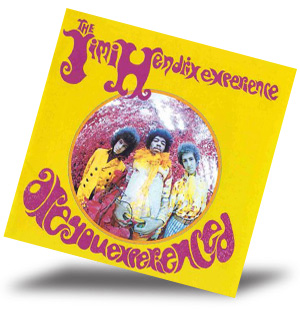
Are You Experienced
as a "AAA pressing." At 20 bucks, the record
seemed worth it, even though I’ve already bought three other
versions, including the CD.
I also own the Japanese mono and UK
pressings, which have a slightly different track lineup.
The Legacy version is a
single LP comprising the original US
song selection. The MCA/Universal version, in contrast, was a
two-record set whose second disc included the songs originally
released on the UK Are You Experienced
(here in the US, those songs made their way
onto
Smash Hits). RTI pressed the
record in Los
Angeles, and their vinyl
quality seems to be exceeded only slightly by Pallas in Germany.
I compared this pressing to both the MCA pressing I bought in 1997
and the LP I bought in the mid-1970s. For the sake of brevity, I’ll
simply note that while the CD sounds good, this music deserves to be
heard in analog.
I
started with a comparison of "Purple Haze" on the three LPs. The MCA
is surprisingly natural and musical for a digital master. Mitch
Mitchell’s snare has a pleasing ring, and Hendrix’s voice, mixed in
the hard-right channel, is clear and well defined. My mid-'70s
Reprise is somewhat murky, though it has plenty of analog warmth.
The mastering on the new Legacy pressing brings more detail and
space to all elements of the recording. You get a much stronger
sense of Mitchell’s foot pedal hitting the kick drum and of the wood
of the drum sticks hitting the snare head. Hendrix’s voice is
sharply focused in the right channel, and it has a more defined,
holographic presence.
The snare drum rolls at the start of "Manic Depression" have more
snap on this new pressing, and when the intro pauses for a second,
you can hear the drum resonating. Hendrix’s guitar has more grain in
its texture than on either of the other pressings, and his voice is
more palpable and real throughout the record. The guitar solos,
which on the Reprise are somewhat folded into the mix, are clearly
set off without sounding overemphasized. Other details, such as the
background vocals on "Hey Joe," are much clearer, but they haven’t
been compressed and they don’t crowd out the lead vocals or
instruments in the soundstage.
Some of the pleasures of
Are You Experienced have always been
its channel panning and tape manipulation, which give the record its
late-1960s aura. Hendrix’s voice, slightly slowed, repeats the
phrase "Purple Haze" behind the closing guitar lines on that track,
and you can hear him more clearly than ever. Mitchell’s toms pan
between the left and right channels on "May This Be Love," and the
tone of the drums, like Hendrix’s guitar tone, has never been more
defined. The lower strings in particular sound fuller and more
natural. When the guitar feedback and slashing drums in "I Don’t
Live Today" part ways as Hendrix says, "There ain’t no life
nowhere," he’s almost frighteningly present in the room.
I could go on picking out
things that I’ve listened to for more than 40 years but find myself
hearing for the first time. The voiceovers and sound effects on
"Third Stone from the Sun" are more audible, as are Mitchell’s
cymbal splashes. Bassist Noel Redding is especially well served
here, and you can tell whether he’s using a plectrum or just his
fingers on each track. The 1997 reissues suggested that a
reassessment of
Redding’s
contribution was overdue, but this pressing makes that task seem
especially urgent.
While I occasionally
wondered if the high end was slightly overemphasized on this master,
a comparison with the CD dispelled that suspicion. The space around
each instrument, as well as the depth of the soundstage, makes this
pressing the definitive version of this astonishing, marvel-filled
record. I can’t imagine a better sounding
Are You
Experienced in any format, and I
feel as if I’m finally hearing it as it should be presented. I’m
ordering
Axis: Bold as Love
as well.
 The English prog rock band
Soft Machine, named after a book by William S. Burroughs, opened for
Hendrix both in
England
and here in the
US.
Chas Chandler, former bassist for the Animals, managed and produced
both artists. The Softs, as their fans affectionately call them,
grew out of a Canterbury-based band called the Wilde Flowers, and by
the time Chandler
and Tom Wilson produced their first album, they were a trio. Kevin
Ayers played bass and sang; Mike Ratledge played an overdriven,
distorted Lowery organ; and Robert Wyatt played drums while sharing
lead-vocal chores with Ayers. Soft Machine combined psychedelic rock
and jazz, with perhaps a hint of classical, to form an unusual sound
that worked because of the musicians’ innovative ideas and skillful
playing. The English prog rock band
Soft Machine, named after a book by William S. Burroughs, opened for
Hendrix both in
England
and here in the
US.
Chas Chandler, former bassist for the Animals, managed and produced
both artists. The Softs, as their fans affectionately call them,
grew out of a Canterbury-based band called the Wilde Flowers, and by
the time Chandler
and Tom Wilson produced their first album, they were a trio. Kevin
Ayers played bass and sang; Mike Ratledge played an overdriven,
distorted Lowery organ; and Robert Wyatt played drums while sharing
lead-vocal chores with Ayers. Soft Machine combined psychedelic rock
and jazz, with perhaps a hint of classical, to form an unusual sound
that worked because of the musicians’ innovative ideas and skillful
playing.
Sundazed Records has
reissued the first two Soft Machine albums on LP in beautifully
mastered editions, housed in excellent reproductions of the original
gatefold covers (though cost probably kept Sundazed from recreating
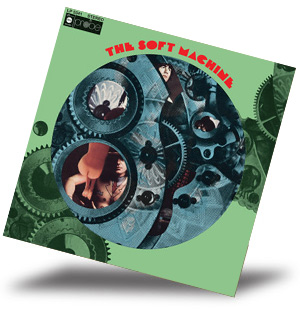
the pinwheel front cover on the first album that predated
Led
Zeppelin III’s by two years). Bob
Irwin remastered both LPs, using the original analog masters as the
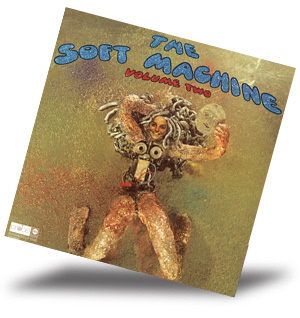
source. The second LP,
The Soft Machine Volume Two,
has been available recently in a
US
pressing, but I haven’t been able to determine who manufactures or
distributes it. I own a copy of that pressing, as well as the CD
that Big Beat released in the
UK
in 1989, which included both titles on a single disc.
Chandler and Wilson recorded the band’s
debut in New York
during a four-day session, and it’s a grand slice of late-1960s
musical ambition and strangeness. Ayers later called it, "unfunky,
cerebral caterwauling." The record was atonal at times, inching
close to the free jazz that would later define the band, but it
often establishes a terrific groove, with Wyatt driving things along
smartly. Wyatt’s oddball tenor singing gives the songs an eccentric
glow, and lyrically the record has its share of English peculiarity.
Ratledge is an exciting soloist, and the distortion he adds to the
Lowery brings grit and energy to many of his solos (he also plays
acoustic piano and the Lowery without effects).
The Sundazed LP improves upon the sound of the decently mastered CD,
giving it a more organic and true sound. Wyatt’s drum taps in the
opening to "Hope for Happiness" ring more sharply across the two
channels, and they reverberate without decaying quickly. Ayers’s
bass has more plonk, and the 1967-era channel ponging of Wyatt’s
drums on "So Boot if at All" has more foundation and gravity.
Wyatt’s multitracked vocals on "Why Am I So Short" are also better
separated and have more weight.
 Ayers left the band after
the first album and went on to a lengthy, well-regarded solo career.
Bassist Hugh Hopper, who had been a road manager for the group and
contributed some songs to the first LP, replaced him.
The Soft Machine Volume Two
consists of two long compositions, "Rivmic
Melodies" and "Esther’s Nose Job," both of which are composed of
shorter musical sections. Wyatt, Hopper, and Ratledge share the
writing credits, and the music moves further into jazz than the
first disc, in part because Hopper is more overtly a jazz player.
But despite its complexity, the music remains approachable. Ayers left the band after
the first album and went on to a lengthy, well-regarded solo career.
Bassist Hugh Hopper, who had been a road manager for the group and
contributed some songs to the first LP, replaced him.
The Soft Machine Volume Two
consists of two long compositions, "Rivmic
Melodies" and "Esther’s Nose Job," both of which are composed of
shorter musical sections. Wyatt, Hopper, and Ratledge share the
writing credits, and the music moves further into jazz than the
first disc, in part because Hopper is more overtly a jazz player.
But despite its complexity, the music remains approachable.
As mentioned, the Sundazed
LP is an improvement over the CD, and a vast improvement over the
other
US
version on vinyl. As just one example, a comparison between the
Sundazed and the other LP shows Wyatt’s vocals on the opening track,
"Pataphysical Introduction-PT I" to be too forward and bright.
Instruments on the Sundazed pressing flow more naturally and have
more resonance and focus than on either of the other versions I own.
The drums sound more open and wooden, and the cymbals have a more
focused edge to them, with less decay. Hopper’s fuzz bass on "Hibou,
Anemone and Bear" is more isolated from the other instruments, and
Ratledge’s organ (which sounds like a reed instrument here) and
guest Brian Hopper’s double-tracked saxophones are more clearly
delineated.
The gatefold covers on
both LPs are first rate, with excellent photo reproduction. The
first LP includes a color photo, and the liner notes of both
records, which sound like they were written by an accountant trying
to be "with it," are a hoot. Soft Machine expanded to a quartet with
Elton Dean on reeds on
Third, which was closer
to free jazz than rock and showed the influence of then current
composers, such as Terry Riley. Their albums through
Sixth
would be unlike anything else in
rock, but by
Seven Soft
Machine was beginning to sound like other jazz-rock fusion bands.
The first two Soft Machine
records, like early King Crimson and Pink Floyd, are from a time
when anything seemed possible in rock music and musicians were
willing to experiment and risk looking foolish. Original copies of
The Soft Machine
and
The Soft Machine Volume Two
command a handsome price, but I’d be surprised
if they sound as good as these pressings.
. . . Joseph Taylor
josepht@soundstagenetwork.com
| "Vinyl
Word" Archived Articles |
-
June 2010 - The 45
Comes Alive
-
April 2010 - Original
Recordings Group
-
March 2010 - Audio Desk Systeme
Vinyl Cleaner
-
January 2010 - Michael Fremer on
DVD
-
October 2009 - Pure Pleasure from
Pure Pleasure Records
-
September 2009 - The Music Really
Matters
-
August 2009 - The Pros and Cons of
LPs Today
-
July 2009 - Bel Canto e.One Phono3
Phono Stage
-
April 2009 - Lamm Industries LP2
Deluxe Phono Stage
-
December 2008 - Blue Circle
Audio BC709 Phono Stage
-
October 2008 - VPI Industries
HW-27 Typhoon Record-Cleaning Machine
-
September 2008 - Tri-Planar
Mk VII UII Tonearm
-
September 2008 - Lyra Argo i
Phono Cartridge
-
August 2008 - Zyx Artisan
Phono Stage
-
July 2008 - Furutech Ag-12
Phono Cable
-
June 2008 - Bellari VP129
Phono Stage
-
June 2008 - Ortofon 2M Black
Phono Cartridge
-
May 2008 - Boston Audio
Design Mat 1 Record Mat
-
May 2008 - TW-Acustic Raven
AC Turntable
-
April 2008 - Zyx Atmos Phono
Cartridge
-
April 2008 - KAB Electro
Acoustics SpeedStrobe and Great Sound Escorts Stereo Canceler
-
March 2008 - Millennium
Audiotrade M-LP Record Mat and Silentor Record Weight
-
February 2008 - Music Hall
MMF 5.1SE Turntable
-
February 2008 - Origin Live
Conqueror Mk III Tonearm
-
January 2008 - Audio
Intelligent Vinyl Solutions Record-Cleaning Fluids
-
December 2007 - Artemis Labs
PH-1 Phono Stage
-
December 2007 - Walker Audio
Prelude Deluxe Record-Cleaning Kit
-
November 2007 - Audio-Technica
AT-OC9ML/II Phono Cartridge
-
October 2007 - CanRong CR-B5
Stylus-Force Gauge
-
September 2007 - Furutech
deStat Antistatic Device and DFV-1 LP Flattener
-
August 2007 - Found on Vinyl:
Karrin Allyson, Annie Ross and Lauren White
-
July 2007 - Found on Vinyl:
Mississippi John Hurt, Son House, and Buddy Guy & Junior Wells
-
June 2007 - Simaudio Moon
LP5.3 Phono Stage
-
May 2007 - Found on Vinyl:
Ella Fitzgerald, Jimmy Smith & Wes Montgomery, and Roy Eldridge
-
April 2007 - Found On Vinyl:
Clark Terry, Rosemary Clooney & Duke Ellington, and Jim Hall
-
March 2007 - Found On Vinyl:
Claire Martin, Madeline Peyroux, and Gerry Mulligan with Scott Hamilton
-
February 2007 - Furutech deMag
LP Demagnetizer
-
December 2006 - Audio Research
PH7 Phono Stage
-
November 2006 - Found on
Vinyl: Kenny Burrell, Hank Mobley, and the Thelonious Monk Quartet with John Coltrane
-
October 2006 - Found on Vinyl:
Three from Opus 3
-
September 2006 - Crystal Cable
CrystalConnect Piccolo and CrystalConnect Micro Phono Cables
-
August 2006 -
21st Century
Vinyl: Michael Fremer’s Practical Guide to Turntable Set-Up
-
July 2006 - Korato Anniversary
Phono Stage
-
June 2006 - Aqvox Phono
2 CI Phono Stage
-
May 2006 - Found on Vinyl: Ray
Brown, Ernestine Anderson, and Ray Charles
-
April 2006 - Pro-Ject
Xperience Turntable
-
March 2006 - Found on Vinyl:
Aaron Neville, Duke Ellington, and Leopold Stokowski
-
February 2006 - Ortofon Rondo
Blue Phono Cartridge
-
January 2006 - Found on Vinyl:
The Who, Neil Young, and The Alan Parsons Project
-
December 2005 - Audio Research
PH5 Phono Stage
-
November 2005 - Nottingham
Analogue Space Deck Turntable and Ace-Space Tonearm
-
October 2005 - Found on Vinyl:
Sarah McLachlan, Beth Orton, and Grey De Lisle
-
September 2005 - ELP
Corporation LT-2XRC Laser Turntable
-
August 2005 - Found On Vinyl:
Primus, Patricia Barber, and John Lennon
-
July 2005 - Found On Vinyl:
Johnny Griffin, Lee Morgan, and Sonny Clark
-
June 2005 - Ayre Acoustics
P-5xe Phono Stage
-
May 2005 - Cardas Audio Myrtle
Silver Heart Phono Cartridge
-
April 2005 - Bel Canto Design
PHONO1 Phono Stage
-
March 2005 - Thorens TD 2010
Turntable
-
February 2005 - Origin Live
Resolution Modern Turntable and Illustrious Tonearm
-
December 2004 - Found on
Vinyl: Like Minds, Jacintha and Lee Morgan
-
November 2004 - Pro-Ject RPM 9
Turntable
-
September 2004 - Found on
Vinyl: The Return of Mobile Fidelity
-
June 2004 - Found on Vinyl:
Maria Muldaur, John Hammond and Eric Clapton
-
April 2004 - Clearaudio
Emotion Turntable, Satisfy Tonearm and Aurum Classics Wood Phono Cartridge
-
March 2004 - Found On Vinyl:
Jimi Hendrix, the Allman Brothers Band, and Pink Floyd
-
December 2003 - Found on
Vinyl: Ray Brown, L.A.4, and Art Blakey
-
November 2003 - MSB Technology
brush-1 Analog-to-Digital Converter
-
October 2003 - Belles 20A
Phono Stage
-
August 2003 - Found on Vinyl:
Peter Gabriel and Holly Cole
-
July 2003 - Found on Vinyl:
J.R. Monterose, Johnny Griffin, and Roy Orbison
-
June 2003 - Lehmann Audio
Black Cube SE Phono Stage
-
May 2003 - Found on Vinyl:
Eden Atwood, Tom Loncaric and His Orchestra, and Mike Bloomfield
-
April 2003 - Linn Adikt Phono
Cartridge
-
March 2003 - Thor Audio
TA-3000 Phono Stage
-
February 2003 - Lamm
Industries LP2 Phono Preamplifier
-
September 2002 - Found on
Vinyl: Sundazed Bob Dylan Remasters
-
August 2002 - Found on Vinyl:
Up, Bustle and Out; DJ Food; and Giant Sand
-
June 2002 - Found on Vinyl:
The Blues on Analogue Productions Originals
-
May 2002 - Clearaudio Champion
Turntable
-
April 2002 - Found on Vinyl:
Bennie Wallace and Jacintha
-
March 2002 - Conrad Johnson
EV1 Phono Stage
-
February 2002 - Found on
Vinyl: Tom Waits, Anthony Wilson Trio and Bill Cunliffe Trio
-
December 2001 - Found on
Vinyl: Blue Note 10" Reissues and the Jon Spencer Blues Explosion
-
October 2001 - Found on Vinyl:
GodSpeed! You Black Emperor and DJ Food
-
September 2001 - Joule Electra
OPS-2 Mk V Phono Stage
-
July 2001 - van den Hul MC-One
Special Phono Cartridge
-
May 2001 - Rotel RQ-970BX
Phono Stage
-
March 2001 - Herron Audio
VTPH-1 Phono Stage
-
December 2000 - Audiomat Phono
1 Phono Stage
-
October 2000 - Balanced Audio
Technology VK-P10 Phono Stage
-
September 2000 - Music Hall
MMF-5 Turntable
-
August 2000 - Audio Research
Reference Phono Preamplifier
-
June 2000 - Lyra Lydian Beta
Moving-Coil Phono Cartridge
-
May 2000 - Groove Note LP plus
45 Vinyl
-
February 2000 - Art Audio
Vinyl One Phono Stage
-
December 1999 - Immedia Needle
Nectar
-
October 1999 - Margules
Magenta FZ47dB Phono Stage
-
September 1999 - The Jimi
Hendrix Classic Singles Collection
-
August 1999 - LAST Record Care
Products
-
July 1999 - Three Slick Gizmos
From KAB Electro Acoustics
-
June 1999 - Blue Circle Audio
BC-23 Phono Stage
-
May 1999 - Rega Planar 25
Turntable
-
April 1999 - Creek OBH-8 Phono
Preamplifier
-
March 1999 - Nitty Gritty
1.5Fi Record Cleaner
-
December 1998 -
Audio Note IQ-2 Phono Cartridge
-
November 1998 -
Blue Note+Vinyl=Classic Records
-
October 1998 -
Wilson Benesch ACT 0.5 Tonearm
-
September 1998
- Do The Tarantella!
-
July 1998 -
Dynavector 10x4 Mk.II Phono Cartridge
-
June 1998 - The
Music Hall MMF-2: An Analog System for the Economically Challenged
-
May 1998 - On a
Safari in America's Heartland
-
April 1998 -
The Virtues of Vinyl
|